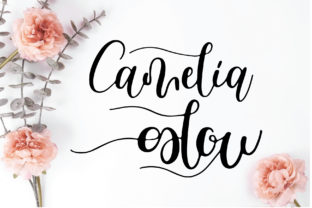
Camelia Glow: A Living Script That Transforms Creative Workflows
Every designer, writer, and creative professional knows the moment when a project needs more than technical precision. It needs personality. That subtle lift that makes someone pause, lean in, and feel something before they even process the words. Camelia Glow delivers exactly that quality. It is not simply another script asset to scroll past in an overcrowded library. It is a carefully constructed expression of movement and warmth that brings handwritten authenticity into digital spaces without sacrificing readability or professional polish.
What makes Camelia Glow genuinely useful is how naturally it bridges the gap between organic lettering and structured design work. The strokes feel intentional rather than simulated. The flow carries the kind of rhythm you find in confident penmanship, where each connection between characters feels deliberate rather than mechanically stitched together. For anyone who has tried to use script assets that look beautiful in isolation but fall apart in longer passages, this distinction matters immediately.
Understanding Where Camelia Glow Fits in Your Process
Script assets often get pigeonholed into narrow use cases. Wedding invitations. Greeting cards. The occasional social media quote graphic. That limited thinking undersells what a well-built script like Camelia Glow can accomplish when you treat it as a functional part of your creative toolkit rather than a decorative afterthought.
Camelia Glow belongs in the early planning stages of any visual project where tone and emotional resonance carry weight. Before you select supporting typefaces, before you lock in color palettes, and certainly before you finalize layout structures, the script you choose establishes the personality baseline. If your headline or hero text needs to feel approachable, human, and confident, this script becomes a foundational decision rather than a finishing touch. That shift in thinking changes how you use it across deliverables.
The practical implication here is straightforward. When you are scoping a branding project, a publication layout, a packaging design, or any content piece where voice matters as much as information, test Camelia Glow early. Drop it into rough comps. See how it interacts with your grid. Pay attention to how it reads at different sizes and in different contexts. Doing this before you commit to complementary elements prevents the common problem of forcing a script into a design that was never built to accommodate its character.
Preparing Your Environment for Smooth Integration
Anyone who has wrestled with script fonts that misbehave in production knows that preparation separates frustration from flow. Camelia Glow rewards a few minutes of upfront attention that pays off throughout your project timeline.
Start with your software environment. Most modern design tools handle high-quality script assets without issue, but the way you access and activate the script determines whether you spend your time creating or troubleshooting. If you work across multiple devices or collaborate with team members, consistent font management becomes essential. Activate Camelia Glow through a reliable manager rather than installing it ad hoc. This keeps versioning clean and prevents the dreaded moment when a file opens with substitution warnings because someone else's system cannot find the asset.
Pay attention to OpenType features if the script includes alternate characters, ligatures, or stylistic sets. Many designers install a script and never explore what it can actually do. Camelia Glow often rewards users who take ten minutes to test its full character set. Swashes, contextual alternates, and discretionary ligatures can transform a standard headline into something that feels custom-lettered. But these features only work if your software supports them and you know how to access them. Test early. Document what works. Share those notes with collaborators.
File Preparation and Format Considerations
If your output is print, verify how the script renders in your export settings. Convert text to outlines before handing off to printers unless they specifically request live text. This protects the integrity of the letterforms and eliminates font embedding issues. For digital work, test rendering across browsers and operating systems. What looks smooth on your high-resolution display may show subtle degradation on older screens. Web font formats, subsetting, and fallback stacks all play a role in maintaining quality across environments.
For content creators and publishers who work primarily in digital spaces, embedding Camelia Glow as a web font requires attention to loading performance and cross-browser compatibility. The script's detailed curves demand clean rendering, so prioritize formats like WOFF2 that balance compression with quality. Test on actual devices, not just browser emulators. A script this nuanced loses its purpose if the end user sees jagged edges or spacing inconsistencies.
Practical Use Across Different Project Types
The versatility of Camelia Glow comes into focus when you examine how it performs across varied applications. Its underlying structure supports readability at surprising sizes, which expands its practical range beyond what many scripts offer.
Branding and identity work benefits from the script's ability to carry logotype responsibilities while feeling genuinely handwritten. When paired with clean sans-serif supporting type, Camelia Glow creates tension between warmth and structure. That contrast drives visual interest without feeling gimmicky. Small business owners and entrepreneurs can build entire visual identities around this dynamic, using the script for primary marks and reducing its usage to accent roles in secondary applications.
Editorial and publishing projects find value in how the script handles pull quotes, section openers, and featured excerpts. Magazine layouts, book interiors, and long-form digital articles gain breathing room when a human script interrupts dense text columns. Readers unconsciously process that shift as a signal that something worth noticing has arrived. The key is restraint. Use Camelia Glow sparingly in these contexts so its impact stays fresh each time it appears.
Marketing and promotional materials tap into the script's ability to convey sincerity. Consumers have grown adept at filtering out corporate visual language. A headline set in Camelia Glow signals something different. It suggests a real person behind the message. For email campaigns, social media graphics, landing page hero sections, and event promotions, that perceived authenticity translates to engagement metrics that sterile typography struggles to match.
Integration with Photography and Visual Assets
Script overlays on photography demand careful contrast management. Camelia Glow's flowing structure interacts with background imagery in ways that blocky typefaces do not. Test placement over different photo regions. Avoid positioning script text over busy areas where letterforms compete with background detail. Use subtle shadows, light overlays, or strategic image cropping to create clean zones for the script to occupy. This attention to legibility amplifies the emotional punch of the combined visual.
Workflow Strategies for Consistent Quality
Consistency becomes the differentiator between a script that elevates your work and one that undermines it. Camelia Glow responds well to systematic approaches that respect its design while integrating it into repeatable processes.
Create a style guide entry specific to how you use this script. Document sizing ranges for different contexts. Note which alternate characters you prefer. Record successful pairings with other typefaces. This documentation prevents drift across projects and helps anyone joining your workflow to produce outputs that feel coherent. A simple reference sheet saves hours of back-and-forth corrections and maintains the professional standard your audience expects.
Template creation deserves attention here. If you regularly produce content types where Camelia Glow appears, build templates that lock in spacing, sizing, and placement. Lock the script's usage parameters so that consistency becomes automatic rather than requiring active decision-making each time. This frees mental bandwidth for the creative aspects of your work while ensuring technical quality remains high.
Collaboration and Handoff Procedures
When passing files to colleagues, clients, or external vendors, the smooth curves of Camelia Glow depend on proper handoff hygiene. Package fonts with your files where licensing permits. Include installation instructions. Note any custom kerning, tracking, or OpenType feature selections you applied. Without this context, recipients may open a file and see something different from what you intended. Clear communication around the script's usage protects your design decisions from accidental alteration.
For developers receiving design files, provide explicit specifications. Font files, fallback declarations, loading strategies, and feature toggles all need documentation. The more thorough your handoff, the closer the final implementation matches your vision. This attention to detail separates professional workflows from amateur ones, regardless of the project scale.
Long-Term Value and Adaptation
A script like Camelia Glow grows with you. Unlike trendy display faces that date themselves within a season or two, well-structured scripts maintain relevance because they tap into something more fundamental. Handwritten letterforms predate digital design by centuries. Their appeal runs deeper than aesthetic cycles.
Invest time in understanding the full range of the script's capabilities now, and you build skills that transfer across future projects. Explore how it behaves in different contexts. Push it beyond your initial assumptions. Test it in applications you have not considered. Each exploration adds to your intuitive understanding of when and how to deploy the script effectively. That knowledge compounds over time, making you faster and more confident in your creative decisions.
For educators and content creators who teach others, Camelia Glow provides an excellent case study in how a single well-chosen asset can anchor diverse creative outputs. Students and learners grasp typographic principles more readily when they can see and feel the difference a quality script makes compared to generic alternatives. Use the script as a teaching tool to demonstrate contrast, hierarchy, mood, and quality control in visual communication.
Making Camelia Glow Part of Your Daily Toolkit
Integration happens through repeated use. The more you work with a script, the more its nuances become second nature. You stop thinking about how to use it and instead focus entirely on what you want to communicate. That fluency is the goal. It transforms a font file into a creative instrument.
Start with small applications. Use Camelia Glow in a single element of your next project. Observe how it changes the overall feel. Note what works and what needs adjustment. Gradually expand its role as your comfort and understanding grow. This incremental approach builds genuine proficiency instead of surface-level familiarity. Before long, reaching for this script when a project needs warmth, personality, and craftsmanship becomes instinctive rather than experimental.
The scripts we choose shape how our messages land. In a digital environment saturated with uniform typography and template-driven design, Camelia Glow offers something genuinely useful. A way to inject humanity into communication without sacrificing professionalism. That balance, executed well, is what transforms ordinary visual work into something people remember and respond to.